 By Bemi Brooks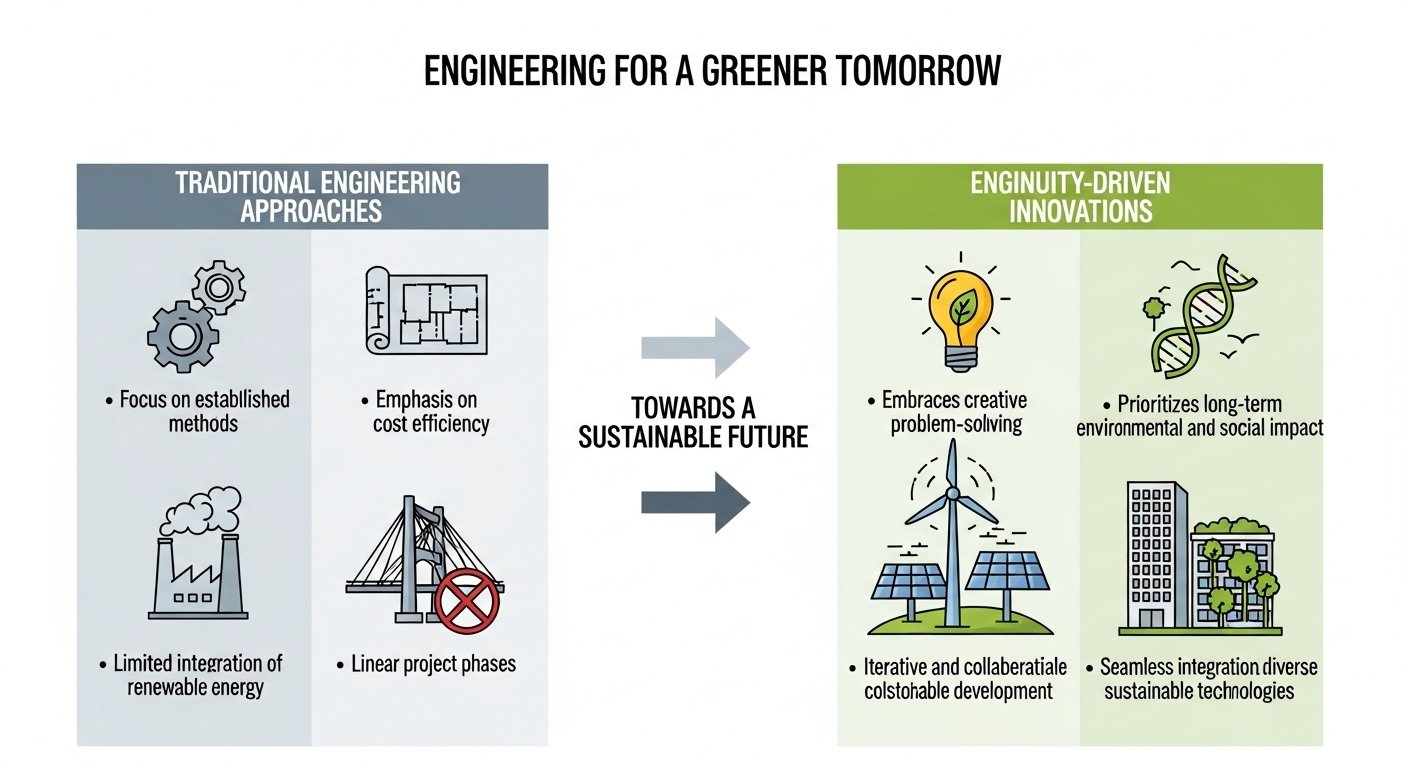
Have you ever watched a bridge span a vast river, defying gravity with elegant curves, and wondered how human minds turned raw materials into such a wonder? That’s enginurity in action: the clever fusion of engineering precision and inventive spark that turns complex challenges into breakthrough solutions.
Enginurity represents the sweet spot where technical know-how meets creative flair, helping innovators tackle problems in ways that are efficient, sustainable, and often surprisingly simple. For forward-thinking entrepreneurs, product designers, engineers, and DIY enthusiasts, embracing this mindset can elevate everyday projects from functional to phenomenal. Research suggests that blending structured engineering with ingenuity leads to more adaptive technologies, though debates persist on whether over-reliance on creativity risks overlooking safety standards. It seems likely that this approach fosters mechanical efficiency and functional aesthetics, especially in fields like industrial design and product development.
Key benefits include cost savings through low-cost innovations, environmental gains via sustainable engineering, and enhanced team dynamics in small groups. However, experts note potential trade-offs, like the need to balance logic with bold ideas to avoid impractical outcomes.
At its core, enginurity is about applying ingenuity to engineering problems, creating solutions that are resourceful and inventive. Think of it as the bridge between rigid formulas and fluid imagination, much like how the Industrial Revolution’s inventors combined steam power with clever mechanics to transform society.
From modern architecture to sustainable tech, enginurity drives progress. For instance, vertical farming uses clever hydroponics to grow food efficiently in urban spaces, reducing water use by up to 95%. Such examples highlight how this mindset can address global issues like food security.
To harness enginurity, start small: encourage brainstorming in teams, prototype with everyday materials, and iterate based on feedback. This practical approach can lead to breakthroughs in your own work.
Imagine standing at the base of the Golden Gate Bridge, feeling the hum of traffic above while the fog rolls in from the Pacific. This iconic structure, completed in 1937, didn’t just connect San Francisco to Marin County; it embodied a revolutionary blend of engineering rigor and creative problem-solving. Engineers like Joseph Strauss faced seismic risks, corrosive salt air, and massive spans, yet they devised innovative suspension systems and aerodynamic designs that have withstood earthquakes and time. This is enginurity: the powerful intersection of engineering principles and human ingenuity that turns daunting obstacles into elegant, enduring solutions.
In a world where challenges like climate change and resource scarcity loom large, enginurity offers a roadmap for forward-thinking entrepreneurs, product designers, engineers, and DIY innovators. It’s not about reinventing the wheel every time, but rather about cleverly adapting it to new terrains. This article explores the concept deeply, from its historical roots to actionable strategies, with real-world examples that show how technical innovation and creative problem-solving can lead to mechanical efficiency, sustainable engineering, adaptive technology, functional aesthetics, and breakthroughs in product development and prototyping.
Enginurity isn’t just a buzzword; it’s the essential bridge between rigid technical standards and fluid creative thinking. Picture engineering as the sturdy framework of a house, providing stability and structure through calculations, materials science, and proven methods. Ingenuity, on the other hand, is the interior design that makes it livable: the clever hacks, unexpected twists, and “aha” moments that add flair and functionality.
Combined, enginurity enables creators to solve complex problems in ways that are efficient, cost-effective, and often environmentally friendly. For instance, when faced with a design flaw, an enginurity-minded engineer might repurpose everyday materials, much like how ancient Romans used arches to build aqueducts that still stand today. This mindset avoids dry, clinical approaches, instead drawing on vibrant, human-centric narratives. It’s like mentorship from history’s great inventors, reminding us that true innovation comes from blending logic with a dash of daring.
Why does this matter for you? In fields like industrial design, where form meets function, enginurity ensures products aren’t just workable but delightful. It addresses common doubts, such as whether creativity compromises safety: evidence from modern projects shows that thoughtful integration actually enhances reliability.
The roots of industrial enginurity stretch back to the Industrial Revolution, a period from the late 18th to early 19th century when inventors transformed agrarian societies into manufacturing powerhouses. In Britain, figures like James Watt refined the steam engine, boosting efficiency by 75% and powering factories, locomotives, and ships. This wasn’t mere tinkering; it was enginurity at scale, combining mechanical know-how with inventive adaptations.
Consider the cotton gin, invented by Eli Whitney in 1793. This simple device separated cotton fibers from seeds 50 times faster than by hand, revolutionizing the textile industry and exemplifying low-cost ingenuity. Later, in the U.S., Henry Ford’s assembly line for the Model T car slashed production time from 12 hours to just 93 minutes, making automobiles affordable for the masses.
These milestones highlight how enginurity fueled economic growth, though not without controversy: rapid industrialization led to labor issues and environmental concerns, sparking debates on ethical innovation. Today, we build on this legacy, applying similar principles to sustainable development.
| Era | Key Innovation | Impact |
|---|---|---|
| 1760s-1840s (First Industrial Revolution) | Steam engine by James Watt | Powered factories, increased production efficiency by 75% |
| Late 19th Century (Second Industrial Revolution) | Assembly line by Henry Ford | Reduced car production time, democratized mobility |
| 20th Century | Cotton gin by Eli Whitney | Boosted textile output, economic shift in agriculture |
This table illustrates how enginurity evolved, from coal-powered machines to electrified systems, setting the stage for modern adaptive technology.
In our fast-paced era, enginurity is more crucial than ever. It drives technical innovation while addressing global challenges like sustainability and resource limits. For entrepreneurs, it means creating products that are not only profitable but resilient. Product designers, for example, use it to blend functional aesthetics with mechanical efficiency, resulting in items like ergonomic tools that reduce user strain.
Engineers and DIY innovators benefit too: enginurity encourages prototyping with limited resources, turning garage experiments into viable solutions. Yet, myths persist, such as the idea that ingenuity undermines logic. In reality, the best outcomes arise from their balance, as seen in projects where creative tweaks enhance structural integrity.
Moreover, in small teams, fostering this mindset boosts collaboration, leading to breakthroughs that larger groups might overlook. As we face climate issues, enginurity promotes adaptive technology, like smart grids that optimize energy use and cut waste by 15-20%.
Modern architecture brims with enginurity, where architects push boundaries with inventive designs. Take the Sydney Opera House, designed by Jørn Utzon: its sail-like shells, initially deemed impossible, were realized through clever geometry and prefabricated segments, creating an iconic landmark that harmonizes with its harbor setting.
Another standout is the Burj Khalifa in Dubai, the world’s tallest building at 828 meters. Engineers at Skidmore, Owings & Merrill used a buttressed core system inspired by Islamic architecture, allowing it to withstand high winds while incorporating sustainable features like condensate recovery for irrigation.
In greener veins, One Central Park in Sydney features vertical gardens that cool the building naturally, reducing energy needs by 25%. This enginurity-led approach blends aesthetics with efficiency, proving architecture can be both beautiful and eco-friendly.
| Building | Innovative Feature | Benefit |
|---|---|---|
| Sydney Opera House | Prefabricated shell segments | Cost-effective construction, iconic design |
| Burj Khalifa | Buttressed core | Wind resistance, height achievement |
| One Central Park | Vertical gardens | Energy savings, urban greening |
These examples showcase architectural brilliance, where enginurity turns visions into realities.
Enginurity shines in design solutions that solve real problems creatively. For instance, the Jaipur Foot, a low-cost prosthetic developed in India, uses rubber and plastic for durability at a fraction of Western costs, helping millions walk again.
In product development, Apple’s iPhone combined touchscreens with intuitive software, revolutionizing communication through clever integration. Such solutions address user needs while pushing technical boundaries.
Low-cost enginurity proves that big impacts don’t require big budgets. The Tata Nano, once the world’s cheapest car at around $2,000, used frugal engineering to strip down features without sacrificing safety, targeting emerging markets.
Another gem: the Embrace Warmer, a portable infant incubator costing $200 versus $20,000 for traditional models, saving premature babies in developing regions with phase-change materials.
DIY examples include cardboard airplanes or catapults made from household items, teaching prototyping on a shoestring.
Sustainability thrives on enginurity. Vertical farming, as in Singapore’s Sky Greens, stacks crops in towers, using 95% less water than traditional methods and producing food locally.
In energy, the Solar Impulse plane circled the globe on solar power alone, showcasing adaptive technology for clean aviation.
Community efforts like Wecyclers in Nigeria turn waste into income via bike-based collection, promoting circular economies.
| Innovation | Key Feature | Sustainability Impact |
|---|---|---|
| Vertical Farming | Hydroponics in towers | Reduces water use by 95%, cuts transport emissions |
| Solar Impulse | Solar-powered flight | Demonstrates renewable aviation potential |
| Wecyclers | Bike recycling | Boosts income, reduces landfill waste |
These initiatives highlight how enginurity supports sustainable engineering.
Small teams are ideal for nurturing enginurity. Start with an open-door culture where ideas flow freely, as at companies like Google, where 20% time for personal projects sparked innovations like Gmail.
Promote autonomy: let team members own tasks, fostering ownership and creativity. Cross-functional collaboration, blending skills from different areas, often yields fresh perspectives.
Regular brainstorming sessions, perhaps with novel activities like walking meetings, can ignite ideas. Celebrate failures as learning opportunities to build resilience.
Balancing logic and enginurity is key to avoiding pitfalls. Logic provides the foundation: data-driven decisions ensure feasibility. Ingenuity adds the spark: questioning norms leads to breakthroughs.
For example, in bridge design, calculations prevent collapse, while creative shapes enhance aesthetics. Use tools like SWOT analysis to weigh options, ensuring innovations are practical.
Ready to apply enginurity? Here are steps:
- Brainstorm Freely: Gather your team for idea sessions without judgment. Use mind maps to connect concepts.
- Prototype Quickly: Build rough models with cheap materials like cardboard or 3D prints to test ideas.
- Seek Diverse Input: Collaborate across disciplines for fresh angles.
- Iterate Based on Feedback: Test, refine, repeat. Tools like CAD software speed this up.
- Incorporate Sustainability: Ask how your solution impacts the environment, aiming for adaptive tech.
- Learn from Nature: Biomimicry, like root-inspired anchors, offers efficient designs.
These strategies, drawn from real successes, can transform your work.
In wrapping up, enginurity empowers us to solve problems like pros, blending engineering with ingenuity for a better future. Remember the Golden Gate Bridge: it’s a testament to what happens when we dare to innovate thoughtfully.
- Start a prototype today with household items.
- Join a makerspace for collaborative brainstorming.
- Read about Industrial Revolution inventors for inspiration.
- Experiment with sustainable materials in your next project.
- Share your enginurity story in the comments below!
What enginurity moment have you experienced? Share below to inspire others!
You May Also Like: Web Development Intro: Why It’s the Best Career Move Today
What exactly is enginurity?
Enginurity is the fusion of engineering principles and creative ingenuity, enabling efficient solutions to complex problems.
How can I foster enginurity in my team?
Encourage open idea-sharing, autonomy, and cross-functional collaboration to spark innovation.
Are there low-cost examples of enginurity?
Yes, like the Tata Nano car or Jaipur Foot prosthetic, both affordable yet impactful.
How does enginurity support sustainable development?
It drives innovations like vertical farming and solar-powered tech, reducing resource use.
Can enginurity be applied in architecture?
Absolutely, as in the Burj Khalifa’s wind-resistant design or green buildings with vertical gardens.
What’s the history behind industrial enginurity?
It began in the Industrial Revolution with inventions like the steam engine, transforming economies.
How do I balance logic and enginurity?
Use data for feasibility while allowing creative exploration, iterating through prototypes.